
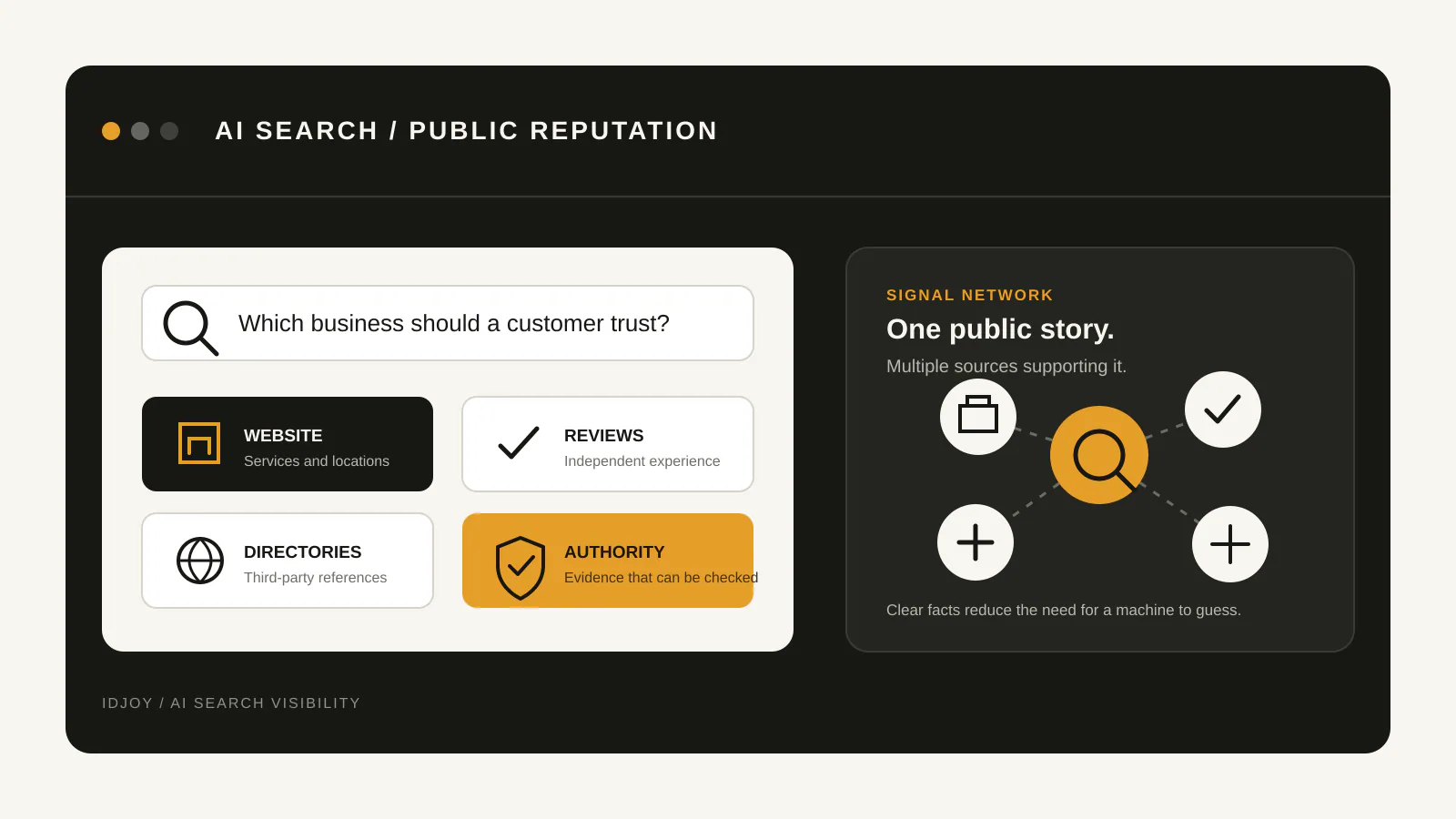
AI search can show a customer a summary before they visit a business's website. Google says its AI features use existing Search fundamentals, and OpenAI identifies OAI-SearchBot as the crawler used to surface sites in ChatGPT Search. A business can make its public information accurate and accessible, but cannot choose or guarantee the answers a platform returns.
Updated 4 November 2026: Replaced outdated ranking and retail claims with current OpenAI and Google guidance, removed unrelated advertising advice, and clarified that Findable ZA is an IDJoy-run directory.
A potential customer may learn about your business before opening your website.
They can ask ChatGPT, Google AI Mode or Perplexity a question such as:
Which risk management consultants serve industrial companies in Gauteng?
These systems can search the web and cite sources, but results vary by platform and question. ChatGPT Search may rewrite a question into targeted searches, while Google’s AI features may use related searches across subtopics. OpenAI explains how ChatGPT Search searches and cites web pages; Google describes query fan-out in AI Overviews and AI Mode.
If a customer sees an AI summary before visiting your website, that summary can become an early impression of your business. OpenAI warns that ChatGPT Search citations can be incomplete, outdated or incorrect, so open the cited pages before relying on a claim.
Start with the public facts a customer can verify: what you do, where you work, who is responsible and what evidence supports your claims.
AI search can combine information across public sources
Depending on the platform and question, an answer may draw on:
- Your website and service pages
- Google Business Profile information
- Customer reviews
- Business directories
- News, industry and partner sites
ChatGPT Search may rewrite a question into targeted searches. Google says AI Overviews and AI Mode may search related subtopics. Perplexity describes its product as searching the web and synthesising information from sources. These descriptions explain product behaviour; they do not disclose a universal ranking formula.
For example, a company’s website might list nationwide coverage while another profile names only Pretoria. One page may still promote a service the company stopped offering. Those conflicts leave customers unsure which details are current and make it harder to identify the right page for a question.
What current platform documentation tells businesses
Google says its AI features use the same Search fundamentals and require no special AI optimisation. A page must be indexed and eligible to appear with a Search snippet, the short preview shown in search results, before it can appear as a supporting link in those features. Google does not guarantee indexing or serving. OpenAI says OAI-SearchBot, an automated crawler that visits web pages, is used to surface sites in ChatGPT Search. Blocking it prevents a site from appearing in ChatGPT Search answers, though the site may still appear as a navigational link. GPTBot has a separate role in model training. These documents describe each platform’s access and eligibility rules; they do not provide a shared formula for recommendations.
Give customers sources they can check
Perplexity says it searches the web, identifies sources and synthesises responses. Its help centre describes how Perplexity works. That description applies to Perplexity, not every AI tool.
When you make a claim, give customers a way to verify it: name the responsible person, link relevant qualifications, describe completed work accurately, and cite credible independent sources where available.
An occupational health service page, for example, can name the responsible practitioner, list the assessments offered and link to relevant registration details. A customer can check those details. A claim such as “the best occupational health service” gives them nothing to verify.
Connect each important claim to evidence customers can inspect: named people, relevant qualifications, completed work, customer feedback or an independent source.
Keep your public business information consistent
Keep your trading name, main services, service areas, contact details and responsible people accurate across your website, business profiles and directory listings. Customers can compare those facts, and search systems have fewer conflicting details to interpret.
Fix unclear service pages before adding more content
If a service page does not explain the work, who it suits, where the company operates and how to enquire, another general article may leave the same questions unanswered. Google’s AI features guidance says its normal SEO fundamentals still apply and calls for helpful, reliable, people-first content. Review the pages customers need before planning more posts.
Five checks that make a business easier to understand
Describe the work and the areas you actually serve. "Commercial fire-equipment servicing for factories in Gauteng" gives customers more to assess than "integrated solutions."
Check the trading name, service category, phone number and website address across your main profiles.
Use accurate author names, biographies, qualifications and experience. Do not claim credentials a person does not hold.
Show case studies, project summaries, verified outcomes or detailed testimonials when you have permission to publish them.
Keep important information in readable HTML, link related pages and check that relevant search crawlers can access them.
Run a short AI search check
Try the same three questions in the AI search tools your customers use:
- What does [business name] do, and where does it operate?
- Which [service] providers serve [area]?
- Which sources support the description of [business name]?
Check whether the service, location and responsible people are accurate. Open the cited sources and note any detail that is wrong, missing or out of date. Fix the first gap on the source page that you control, then repeat the same questions later. Answers vary by platform, query and time, so treat one result as an observation rather than a permanent ranking.
Optional: submit your business to IDJoy’s Findable ZA directory
IDJoy runs Findable ZA, a directory for South African service businesses. Its founding release accepts submissions for electricians, plumbers, landscapers and garden services, automotive repair businesses, cleaning and maintenance services, and driving schools in Pretoria, Centurion and Tshwane.
You can submit a business for review, but IDJoy does not publish submissions automatically. The form also accepts another service category and other South African service areas; inclusion still depends on review.
Because IDJoy operates the directory, a listing is not an independent endorsement. Submission is free during the founding release and does not guarantee publication, rankings, leads or AI recommendations.
Request a directory review
Use the submission form to request review. If you also want IDJoy to assess your website and online visibility, select the separate assessment option in the form.
Submit a business