
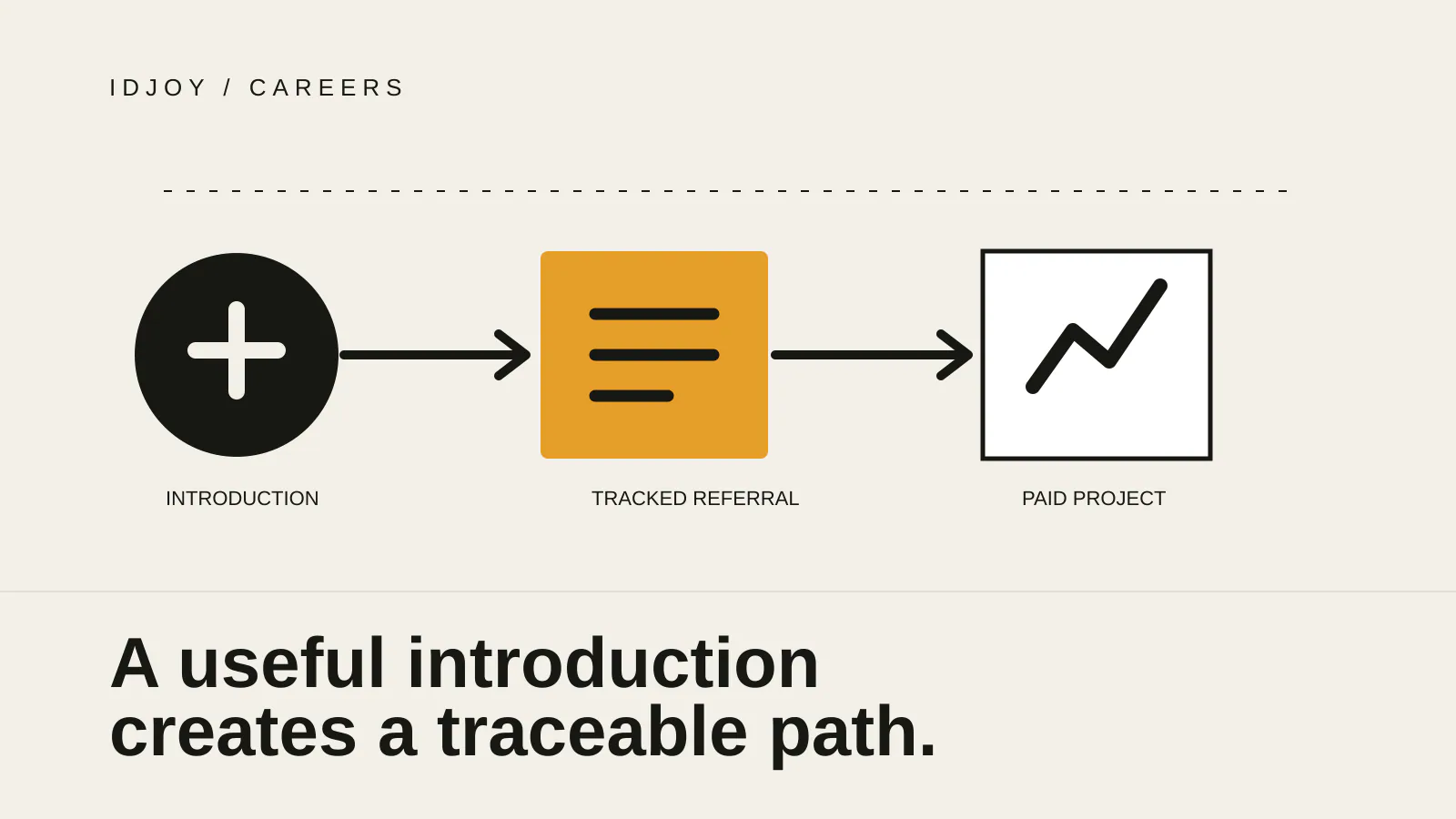
Referral income is earned by making a traceable introduction that becomes a paid project. A legitimate programme should be free to join, explain the work and commission rules, disclose when payment becomes due, and never promise guaranteed income. With IDJoy, partners introduce suitable South African businesses while IDJoy handles the sales conversation, quotation, delivery and invoicing.
Before joining a referral programme, check who handles the sales conversation, when commission becomes payable and what triggers payout. You need to identify a business with a real need, make a relevant introduction and wait for its decision.
Update note, 5 November 2026: IDJoy’s published commission rates, payout trigger and SARS tax guidance were checked.
What referral income means
Referral income is commission paid after your introduction creates measurable business for another company.
In the IDJoy partner programme, that usually starts when you notice a South African business with a digital problem, such as:
- a company using only Facebook or WhatsApp with no website;
- a business still sending quotations from a free personal email address;
- a website that does not explain specialised services clearly;
- a new business that needs a logo, profile and professional presence;
- an established company that cannot be found when buyers search online; or
- a team losing enquiries because its website has no clear next step.
You are not expected to design the website, calculate the price or promise a result. Your role is to identify a reasonable fit and make the introduction. IDJoy handles the sales conversation, scope, quotation, work and invoicing.
How the process works
1. Register without paying a joining fee
A referral programme should not require you to pay before you can earn. IDJoy does not charge a joining fee, require stock or create paid ranks that unlock higher levels.
After registration, your partner profile receives a referral code and a shareable link. The link makes it possible to trace a website enquiry back to your profile.
2. Look for a real business problem
A useful introduction names an observable business need and asks permission to connect the business with a provider.
Compare these two approaches:
“Hi, do you need a website?”
and:
“I noticed your company profile lists five industrial services, but your current page does not separate them or show how a buyer should request a quotation. I work with a web studio that solves that type of problem. May I introduce you?”
3. Disclose your relationship
Tell the business that you may earn commission if a project closes. Disclosure protects trust and makes it clear that you are introducing a provider, not pretending to give completely independent advice.
A simple line is enough:
“For transparency, I am part of IDJoy’s referral programme and may earn commission if you choose to work with them.”
Do not hide the relationship in small text or wait until after the introduction.
4. Use the referral link or add the project
Your referral link is useful when the business wants to inspect IDJoy’s work first. You can share it through WhatsApp, email or another relevant conversation.
To add a business yourself, sign in to the partner portal and submit the project details. IDJoy connects the introduction to your partner profile; you do not enter a partner ID manually.
IDJoy’s public programme page says logging a referral reserves the client to that partner for 180 days. It does not say whether a project that closes after the reservation expires still earns the original partner a commission, or how competing claims are resolved. Ask IDJoy to confirm these terms before submitting a referral that may overlap with another partner’s introduction or close later.
5. Follow the real outcome
An introduction is not automatically a sale. The business may decline, delay the decision, request a smaller service or choose another provider.
Your dashboard shows the referral’s status. “Submitted” means IDJoy has received the introduction. “Contacted,” “qualified” and “quoted” show that the sales conversation is moving forward. “Won” means the project closed and IDJoy recorded its value and commission. “Lost,” “duplicate” and “rejected” mean that referral will not proceed.
IDJoy marks the commission payable when a project closes, then pays it after the client settles the invoice. The dashboard shows the payment reference against the referral.
How much can a referral pay?
IDJoy currently lists commission rates of 10% to 15%. At the published R4,199 price for a five-page website, that works out to R419.90 to R629.85. IDJoy says it pays commission after the client settles the invoice. Prices, rates and terms can change, so check the current programme page before estimating income.
Base essential expenses on money you have received, not on a lead that has not closed.
Who is this suitable for?
Referral work can suit people who already speak to business owners or regularly notice business problems, including:
- accountants, consultants and business-support practitioners;
- print shops, photographers and signage companies;
- salespeople and account managers;
- community organisers and networking-group members;
- freelancers whose clients need services outside their own scope;
- employees who meet suppliers and small-business owners through normal work; and
- founders who frequently receive requests they cannot fulfil themselves.
Check your employment agreement before doing outside work. Avoid using confidential employer information, company time or relationships you are not authorised to approach.
What referral income is not
Referral income has no fixed salary or guaranteed payment. IDJoy pays for closed business projects, not for recruiting other partners. Avoid mass messages; contact a business when you can name a relevant need.
Keep records for tax purposes
SARS states that other income, including income from business activities, may be taxable. Whether tax is due depends on your total income and circumstances.
Keep:
- payout statements;
- proof-of-payment documents;
- dates and payment references;
- relevant expenses and supporting records; and
- any tax advice you receive.
Do not rely on a social-media post to decide whether you must register, declare income or submit provisional tax. Use current SARS information or consult a registered tax practitioner.
Check the programme terms before you register
Read the published commission examples, the attribution rules and the payment conditions. Confirm that the programme is free to join and that you understand what happens when a lead duplicates an existing referral.
Then decide whether you know the kinds of South African service businesses IDJoy is built to help.
Review the Earn With IDJoy partner programme or read the careers and extra-income hub.