
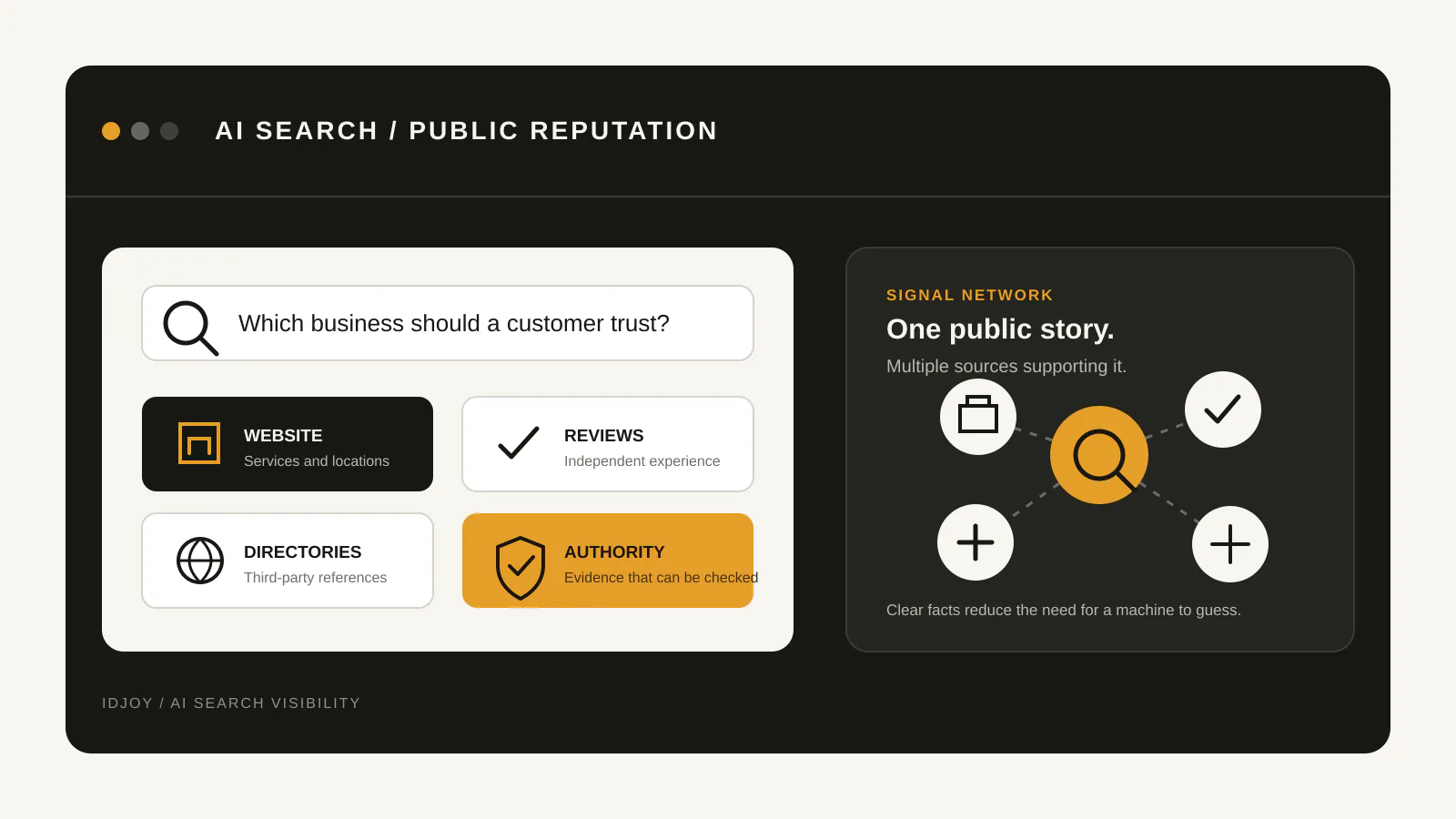
You cannot guarantee an AI citation. You can improve citation readiness by making important pages crawlable, answering specific questions with verifiable facts, linking claims to primary sources, publishing original evidence, keeping business details consistent and earning legitimate third-party mentions. Measure which pages and sources appear in repeat prompt tests, then fix the weakest evidence rather than buying a guaranteed GEO placement.
A citation is an output of an AI system. It is not a placement you can buy from the model.
That makes “guaranteed GEO citations” a weak way to evaluate an AI visibility provider. The provider can control work on your website, public business information, measurement and outreach. It cannot control the answer another company’s model generates for every user and prompt.
A better target is citation readiness: make your business easy to retrieve, understand, verify and connect to a useful source.
Start with a page worth citing
An AI system has little reason to cite a page that says only:
We provide innovative, world-class solutions tailored to your needs.
The sentence makes a claim without giving the reader a useful fact.
A citation-ready page answers a specific question with material another person can check.
For a service page, that might include:
- the exact service;
- who the service is for;
- the location or service area;
- what is included;
- how the process works;
- real pricing context where appropriate;
- evidence from completed work;
- standards or rules that apply;
- a clear route to the business.
Specific information improves the page for people first. It also gives search systems clearer passages to retrieve.
Put the direct answer near the question
Do not make a reader cross six paragraphs of introduction to find the answer promised by the title.
If the page asks “What should a South African tax invoice contain?”, answer that question early. Then explain the requirements, exceptions and sources.
The same applies to commercial questions:
- How much does a five-page website cost?
- Should I use WordPress or custom code?
- What should a service page include?
- Can this company serve Johannesburg if it is based in Pretoria?
A short direct answer creates a useful passage without reducing the rest of the article to a list of keywords.
Support factual claims with primary sources
When a page discusses legislation, tax, platform rules, technical standards or product features, link the factual claim to the organisation responsible for it.
For example:
- SARS for South African VAT rules;
- Google for Google Search or Business Profile requirements;
- Microsoft for Microsoft 365 configuration;
- OpenAI for ChatGPT Search crawler guidance.
A primary source does two things. It lets the reader verify the statement and separates evidence from your interpretation of it.
Do not add a source simply because it contains the same keyword. The source must actually support the claim beside it.
Publish evidence you own
Third-party citations matter, but your website can also become an original source.
Useful original evidence includes:
- a case study with a documented starting problem and completed work;
- a benchmark you collected using a repeatable method;
- screenshots of a process where privacy permits;
- a comparison table built from published provider information;
- a tested checklist;
- a calculator or useful free tool;
- an original survey with the method and sample disclosed.
Avoid invented performance figures. “We increased conversions by 300%” is not evidence when there is no baseline, date, measurement method or client approval behind it.
If you cannot publish the number, explain the work without pretending you can.
Make authorship and business identity clear
A useful article should not feel detached from the organisation responsible for it.
Keep these elements consistent:
- business name;
- author or editorial owner;
- About page;
- service pages;
- contact details;
- location or service area;
- structured data where appropriate;
- Google Business Profile;
- major third-party profiles.
The goal is not to repeat the same paragraph everywhere. The goal is to remove contradictions.
If one page says the business is in Pretoria, another says Johannesburg and a directory shows Cape Town, the identity becomes harder to verify.
Let crawlers reach the useful content
Citation work fails when the source cannot be retrieved.
Google says normal Search eligibility remains the foundation for supporting links in AI Overviews and AI Mode. OpenAI states that publishers should allow OAI-SearchBot if they want their public pages available for ChatGPT search summaries and snippets.
Check:
- robots.txt;
- CDN or firewall bot rules;
- status codes;
- canonical tags;
- noindex directives;
- JavaScript rendering dependencies;
- accidental login walls;
- geo-blocking;
- broken internal links.
Do not open private areas of a website simply to improve AI visibility. Public marketing content and private customer information require different access rules.
Build independent corroboration legitimately
Your own website says what you claim about the business. Independent sources can show whether anyone else has reason to recognise it.
Potential sources include:
- customer reviews based on genuine experiences;
- supplier or partner directories;
- professional associations;
- client case studies that name the business with permission;
- event speaker pages;
- local business directories with accurate details;
- press coverage earned from a real story;
- public project or procurement references where appropriate.
Do not buy fake reviews, fabricated news placements or directories created only to repeat the same paragraph. More mentions are not automatically stronger evidence.
Write passages that can stand on their own
Search systems often retrieve parts of pages, not only the page as a whole.
A heading and the paragraph beneath it should make sense when read together.
Weak:
Why it matters
This is important for businesses that want to succeed.
Stronger:
A service-area page should not pretend you have an office there
State that you serve the city and explain how the service works. Do not publish a fake branch address to make the page look local.
The second passage contains the subject, recommendation and limitation without depending on the previous section.
Measure citations as observations, not entitlements
Use a fixed prompt set and record:
- engine;
- date;
- prompt;
- whether the business appeared;
- cited source;
- accuracy;
- landing page;
- commercial relevance.
A citation to an old directory with the wrong phone number is not a success.
A citation to your service page for a high-intent query may be more valuable than ten mentions for broad informational prompts.
Track the result alongside real enquiries where attribution is possible.
Ask a GEO provider what they actually control
Before paying for an AI visibility service, ask:
- Which pages will you change?
- How will you test crawler access?
- What business facts will you reconcile?
- Which primary sources will support factual claims?
- What original evidence will we publish?
- How will third-party mentions be earned?
- Which prompts and engines will be tested?
- How will inaccurate answers be documented?
- How will AI referrals and enquiries be measured?
- Which outcomes are outside your control?
A provider should be able to explain the work without promising a permanent citation.
Citation readiness is a system
No single schema tag, llms.txt file, prompt trick or content format guarantees inclusion.
The durable work is less dramatic: accessible pages, clear answers, consistent identity, useful evidence, credible sources and repeatable measurement.
That is also why the same work often improves conventional search and customer trust. It makes the business easier to verify before anyone asks an AI system to recommend it.
IDJoy’s AI search visibility service works on those controllable inputs and reports observations rather than selling guaranteed model placement.