
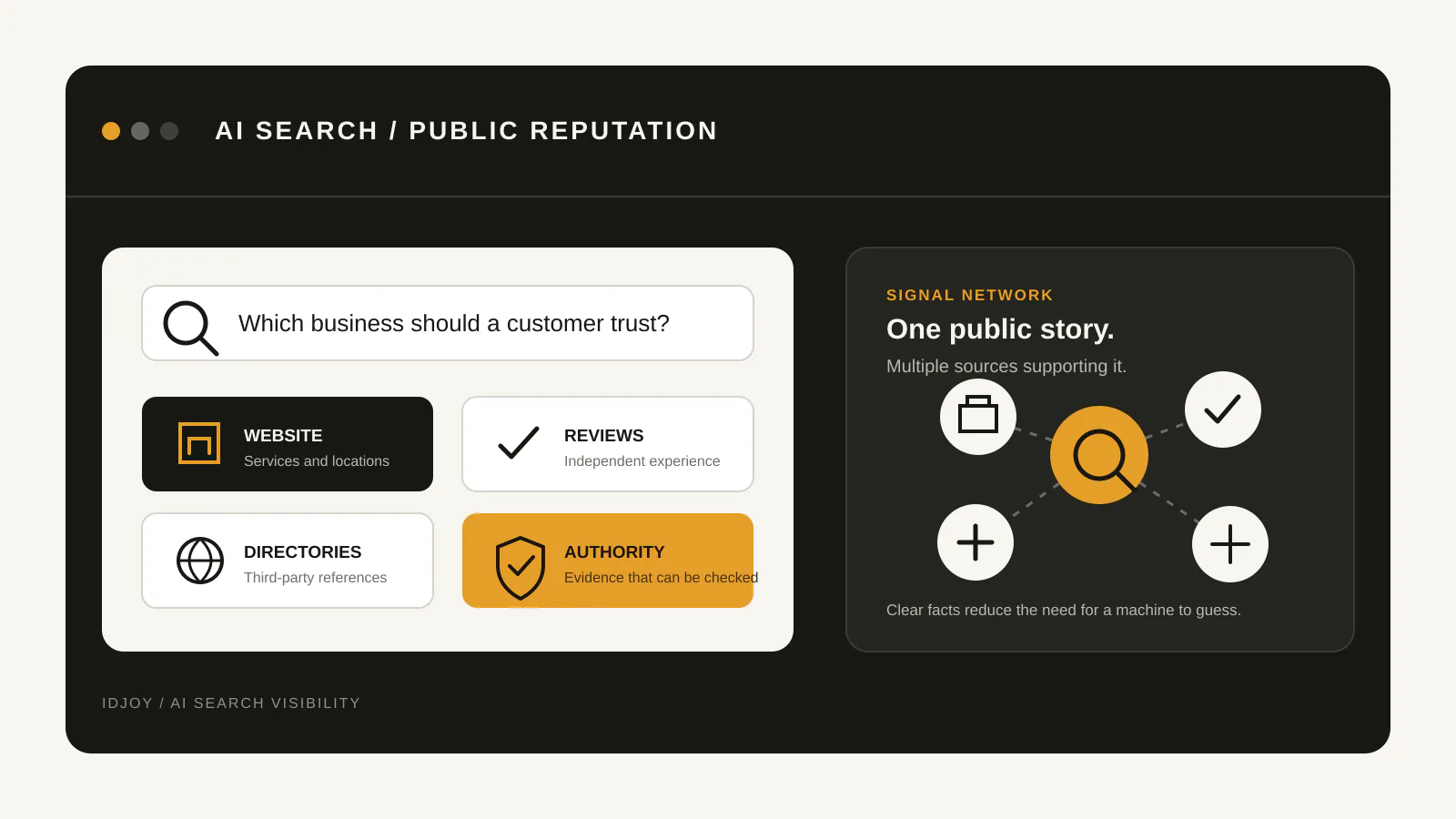
AI search may recommend competitors when their public evidence is easier to retrieve and verify. Compare crawler access, service-page specificity, location signals, case studies, reviews, independent mentions, business-detail consistency and the quality of the cited landing pages. Do not assume the answer is a fixed ranking. Use repeated buyer-intent prompts to find the evidence gap you can actually improve.
When an AI answer recommends three competitors and leaves your business out, the tempting reaction is to rewrite the whole website.
Do not start there.
First identify which layer of evidence is weaker. The answer may reflect access, entity recognition, local signals, service depth, reviews, independent sources or simply the wording and context of that prompt.
Reproduce the problem before diagnosing it
Save the exact prompt that produced the competitor list.
Then run a small controlled set around the same intent:
- best [service] in [city];
- compare providers for [service];
- trusted [service] company in [city];
- provider with experience in [specific customer problem];
- alternative to [competitor] for [service].
Record every provider that appears.
One answer can be unstable. A competitor that appears across several prompts and engines gives you a stronger comparison target.
Check whether your important page can be retrieved
Before comparing copy, confirm that the service page is technically available.
Review:
- status code;
- robots.txt;
noindex;- canonical URL;
- CDN bot rules;
- internal links;
- sitemap inclusion;
- core content rendering.
If the competitor’s service page is accessible and yours is blocked, that is the first gap to fix.
Do not add more words to a page a crawler cannot reach.
Compare the actual service evidence
Open your page and the competitor page side by side.
Ignore visual style for a moment. Compare what a buyer can verify.
| Evidence | Your page | Competitor |
|---|---|---|
| Exact service named | ||
| Customer problem explained | ||
| Service area clear | ||
| Process explained | ||
| Relevant proof | ||
| Pricing context | ||
| Case study | ||
| Contact route |
A competitor does not need a longer page to have stronger evidence. One specific case study can carry more useful information than five sections of generic claims.
Check whether your business identity is consistent
AI systems can use more than your website.
Compare the public facts across:
- website;
- Google Business Profile;
- social business profiles;
- directories;
- partner or supplier pages;
- review platforms;
- press or event pages.
Look for conflicting names, old domains, old telephone numbers, previous addresses and services you no longer offer.
If the competitor has one clear identity across those sources while your details conflict, correct the business-controlled records first.
Compare local evidence, not fake location pages
For a local query, a competitor may have stronger evidence that it genuinely operates in or serves the area.
Useful evidence can include:
- verified Business Profile information;
- genuine customer reviews mentioning the service and area;
- real project case studies;
- a clear service-area statement;
- local partner or association pages;
- accurate contact and address information.
Do not respond by creating fake offices or dozens of thin city pages.
If you serve Johannesburg from Pretoria, say that clearly and explain the service model.
Look at the sources the answer cites
A competitor recommendation is more useful when you can see why it happened.
Record the supporting links where the engine exposes them.
Ask:
- Is the source the competitor’s website?
- Is it a review platform?
- Is it a directory?
- Is it a client article or partner page?
- Is it a comparison article?
- Is the cited source recent?
- Does it contain evidence you lack?
Do not copy the source strategy mechanically. A professional association listing may be relevant for one industry and meaningless for another.
Separate reputation from popularity
A competitor with more reviews may have stronger public proof, but raw review count is not the only signal worth studying.
Read the reviews.
Do customers describe:
- specific services;
- locations;
- outcomes;
- staff or process;
- repeat work;
- problems and resolutions?
Genuine, detailed feedback tells a richer story than a wall of identical five-star comments.
Your response should be to improve the review-request and service process, not to manufacture volume.
Compare case studies and proof
A portfolio image says “we made this”. A case study can explain:
- the problem;
- constraints;
- work completed;
- decisions;
- evidence of the result;
- what was not measured.
When a buyer asks an AI system for a specialist with proven experience, that structure gives the web more specific material to retrieve.
If you do not have permission to publish client results, use a process case study or anonymised evidence without inventing numbers.
Check whether your content answers the buyer’s actual question
A homepage may rank for the company name but fail a specific service prompt.
Map each high-intent prompt to the page that should answer it.
For example:
| Buyer prompt | Best destination |
|---|---|
| Web designer in Pretoria | Local/service page |
| Website redesign for lead generation | Redesign service page |
| Web design prices South Africa | Pricing page |
| Does this provider have proof? | Case study hub |
If every prompt points to the homepage, the site may not have enough depth for the buyer’s decision.
Inspect the competitor’s conversion path too
A recommendation is more commercially useful when the cited destination helps the buyer act.
Compare:
- CTA clarity;
- WhatsApp or phone route;
- enquiry form length;
- mobile readability;
- price or scope clarity;
- trust signals near the decision;
- response expectations.
This does not necessarily cause the recommendation, but it determines whether visibility becomes an enquiry.
AI visibility without a usable landing page can send traffic into a dead end.
Turn the gap into a work order
Do not create a list called “Improve GEO”. Write a specific action.
Examples:
- Allow OAI-SearchBot to access
/website-redesign/. - Correct the old telephone number on two directories.
- Replace generic service copy with the actual deliverables and process.
- Publish the approved case study from the Pretoria engineering project.
- Add an accurate Johannesburg service-area section without claiming an office.
- Request reviews from completed customers using Google’s official review link.
- Track WhatsApp starts from the cited service page.
Each action should have an owner and a way to verify it.
Retest the same prompt set
After meaningful changes, rerun the original prompts.
Compare:
- whether the business appears;
- which competitors appear;
- factual accuracy;
- citations;
- landing destination;
- qualified enquiry evidence.
Do not expect every prompt to change immediately. Search systems crawl, index and retrieve information on their own schedules.
The goal is to improve the public evidence you control and measure whether the observable results move over time.
IDJoy’s AI visibility service uses this gap-based approach instead of promising that a model will recommend one business above every competitor.