
Clear payment terms reduce avoidable delays by stating the due date or payment period, payment method, reference, deposit or milestone requirements, dispute contact and next steps. Put the important terms on the quote or agreement before the invoice arrives. Wording cannot guarantee payment; customer approval processes, cash flow and your follow-up system also affect timing.
“Payment due soon” is not a payment term.
A useful invoice tells the customer what is due, when it is due, how to pay and what to do if something is wrong.
Clear terms cannot guarantee on-time payment. They can remove delays caused by ambiguity, missing references, procurement questions and invoices that arrive with rules the customer never saw before.
Agree the terms before the invoice
The best time to discuss payment is usually before the work begins.
Put the core terms in the quotation, proposal, order form or contract:
- deposit;
- milestone payments;
- final balance;
- payment period;
- VAT treatment where applicable;
- third-party costs;
- approval process;
- cancellation or rescheduling terms where relevant.
Then the invoice should reflect what was already agreed.
Do not introduce a new seven-day payment rule on the final invoice when the customer accepted a quote that said 30 days.
Use a specific due date
“Net 30” may be understood by an accounts team. “Payment due 8 September 2026” removes another calculation.
A clear invoice can show both:
Invoice date: 9 August 2026
Payment terms: 30 calendar days
Due date: 8 September 2026
If your business uses working days instead of calendar days, say so.
Do not rely on “within 30 days” when the starting date is unclear.
Use deposits for work that starts before delivery
A deposit can reduce the supplier’s exposure on project work.
Example structure:
50% deposit to schedule the project
40% at approved design stage
10% before final launch/handover
That is only an example. Choose milestones that match the actual work and agreement.
Do not call every upfront payment a “non-refundable deposit” by default. The legal effect depends on the contract, circumstances and applicable law. Use terms reviewed for your business where refunds or cancellations carry material risk.
Match milestone payments to work the customer can verify
A milestone should describe an event both sides can recognise.
Better:
- deposit on acceptance;
- design approval;
- development staging review;
- final pre-launch approval.
Weaker:
- phase two payment;
- halfway payment;
- progress payment.
If a project changes scope, document the change before invoicing the extra work.
Make banking details easy to verify
Show:
- account holder;
- bank;
- account number;
- branch code where relevant;
- account type if useful;
- payment reference.
Keep the account holder consistent with the business identity or clearly explain the relationship where the lawful operating structure differs.
Because invoice fraud often involves changed banking details, establish a verification process for account changes. A customer should not rely on an unexpected email saying “please use our new bank account” without another trusted check.
Give the customer a payment reference
A reference helps match the payment to the invoice.
Useful references include:
- invoice number;
- customer account number;
- project reference.
Example:
Payment reference: INV-2026-061Avoid references such as “website” when the customer has several open invoices.
Put purchase-order requirements in the process early
Large customers may reject an invoice without a valid purchase-order number, vendor number or department code.
Ask before work starts:
- Is a PO required?
- Who creates it?
- Must the PO appear on the invoice?
- Which legal entity should be invoiced?
- Which accounts-payable email receives invoices?
- Is supplier onboarding required?
An invoice can be perfectly designed and still sit unpaid because procurement cannot process it.
Tell customers where to send a dispute
A customer who sees an incorrect line item should not have to reply to a no-reply address.
Include a route such as:
Questions about this invoice: accounts@example.co.za
or the appropriate business contact.
For a small company, that can be the same person who manages the project.
The point is to resolve a genuine dispute before it becomes a silent overdue balance.
Separate payment terms from service terms
An invoice does not need to reproduce the entire contract.
Keep the payment section focused:
- amount due;
- due date;
- payment method;
- reference;
- deposit/milestone basis;
- agreed late-payment or interest wording where legally appropriate;
- query contact.
Link or refer to the signed service agreement for broader clauses such as intellectual property, project cancellation and liability.
Do not invent late fees after the customer is already overdue
If the business wants to charge interest or a late-payment fee, make that part of the agreement before the amount becomes due and make sure the term is lawful and appropriate for the transaction.
Do not add a surprise 10% fee because an invoice was seven days late when no such term was agreed.
The correct legal treatment can depend on the contract, customer type and applicable South African law, so high-value or recurring credit terms deserve professional review.
Use reminders as an operational system
Terms do not send reminders by themselves.
Build a simple sequence that matches the customer relationship.
Example:
Before due date
Send the invoice and confirm it reached the correct accounts contact.
On due date
Send a concise reminder with the invoice number, amount and payment link or banking reference.
A few days overdue
Ask whether there is a processing problem, missing PO or dispute.
Materially overdue
Escalate according to the agreed credit-control process.
Do not send an aggressive final-demand message the morning after a long-term customer’s first missed due date unless the agreement and situation justify it.
Confirm invoice receipt for larger accounts
For important B2B invoices, “sent” and “received by accounts payable” are different states.
Record:
- invoice sent date;
- recipient address;
- delivery confirmation where available;
- PO/reference included;
- approval owner;
- due date;
- follow-up date.
This catches the common failure where the invoice went to the project manager but never reached finance.
Keep terms proportional to the job
A R500 once-off service does not need a two-page payment policy on the invoice.
A six-month project with subcontractors, milestone payments and third-party software costs needs more structure.
Scale the terms with:
- project value;
- duration;
- supplier costs;
- customer procurement process;
- credit risk;
- number of milestones.
Clarity is the goal, not maximum legal text.
Use plain language
Weak:
All sums shall become immediately due and payable without deduction or set-off upon presentation thereof.
Clearer for an ordinary invoice when it reflects the actual agreement:
Payment is due by 8 September 2026. Use invoice number INV-2026-061 as the payment reference.
Legal clauses sometimes need formal language. Put them in the correct contract rather than turning every invoice note into a legal document the customer cannot scan.
Build a payment-terms block you can reuse
A simple template can include:
Payment terms: [X days / milestone]
Due date: [date]
Payment method: [EFT / card / other]
Reference: [invoice number]
Banking details: [verified account details]
Invoice queries: [contact]
PO / vendor reference: [if required]
Then add only the extra terms needed for that customer or project.
Track why invoices become overdue
Do not assume every late invoice has the same cause.
Add a reason code:
- customer cash-flow issue;
- invoice not received;
- incorrect legal entity;
- missing PO;
- disputed work;
- wrong amount;
- approval delay;
- banking verification;
- supplier forgot to follow up.
After several months, fix the recurring process issue.
If missing POs create most delays, the solution is not a stronger red “OVERDUE” stamp. It is getting the PO before work begins.
Use the invoice generator after the terms are decided
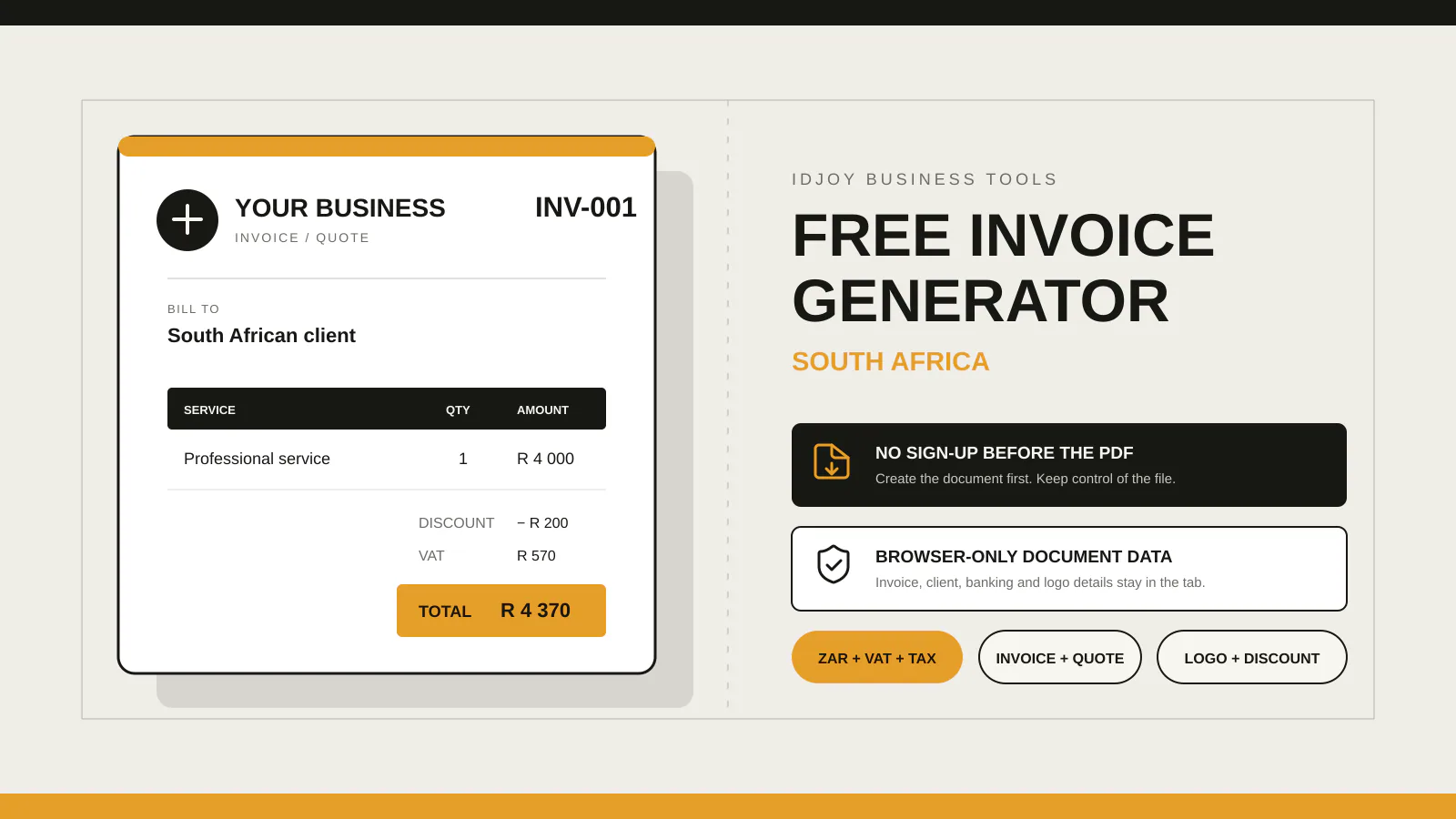
IDJoy’s free Invoice Generator gives you fields for notes, banking details and terms so the final PDF can carry the agreed payment information.
The tool does not negotiate the terms or enforce payment.
Use the downloadable template pack below to define the wording your business actually uses, then open the free IDJoy Invoice Generator to place it on the document.