
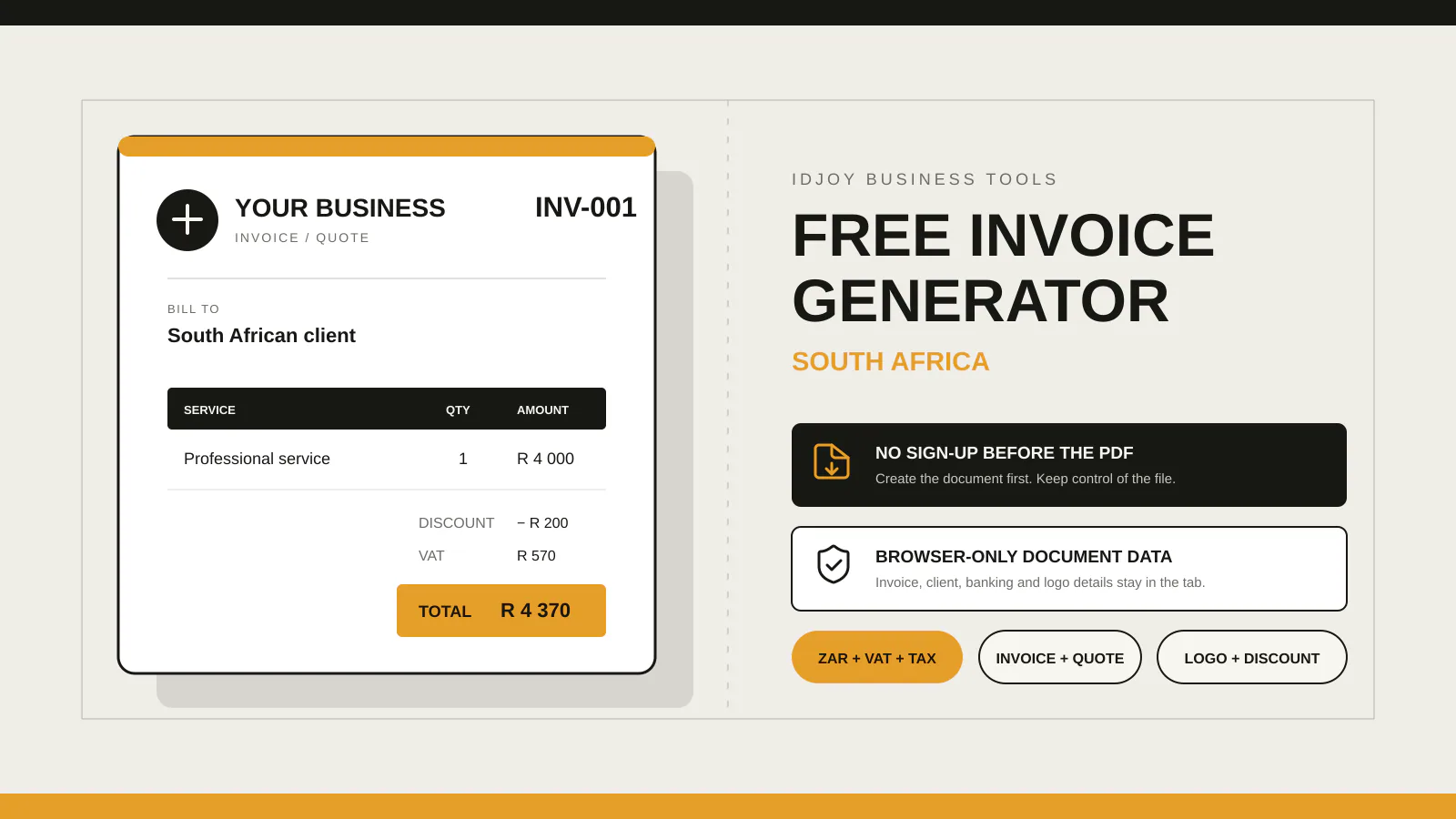
A PDF invoice is an electronic document a person can read. Structured e-invoicing exchanges machine-readable invoice data between systems. SARS applies normal VAT invoice and record-keeping requirements to electronic invoices and says prior approval is not needed to implement e-invoicing. As of August 2026, SARS has discussed broader e-invoicing infrastructure, but current public guidance reviewed for this article does not establish a blanket real-time mandate for all businesses.
A PDF invoice and an e-invoice can both be electronic. They are not always the same thing.
The distinction matters when a software vendor says your business “needs e-invoicing” without explaining whether they mean emailing a digital tax invoice or exchanging structured invoice data directly between systems.
A PDF is an electronic document for people
A PDF invoice is usually designed to preserve a page layout.
It can contain:
- supplier details;
- customer details;
- line items;
- VAT information where applicable;
- payment terms;
- banking details;
- logo and brand styling.
The customer can open it, read it and save it.
The accounting system may still require a person, OCR process or import tool to capture the invoice data.
That is different from structured data flowing directly into another system.
Structured e-invoicing is designed for systems as well as people
In many modern invoicing contexts, “e-invoice” means the invoice data is represented in a structured machine-readable format.
The exchange can carry fields such as:
- invoice identifier;
- supplier and buyer identifiers;
- dates;
- line descriptions;
- quantities;
- tax categories;
- VAT values;
- totals;
- payment information.
The recipient’s software can process those fields without treating the invoice as only a picture of a page.
A human-readable rendering may still be generated for review.
SARS has recognised electronic tax invoicing for years
SARS stated in VAT Connect Issue 6 that the VAT Act’s requirements for tax invoices, debit notes, credit notes and record retention apply equally to vendors that use e-invoicing.
SARS also said vendors do not need prior approval from the Commissioner to implement e-invoicing. Electronic transmission and retention must still comply with the relevant legal requirements, including electronic communications law.
That means “electronic” does not remove the normal tax-invoice rules.
A digital invoice still needs the required VAT information for the transaction.
Do not assume South Africa already has a blanket real-time mandate
Electronic invoicing rules change quickly in many countries.
For South Africa, SARS has publicly discussed a future common payment platform with e-invoicing as part of broader government modernisation. That statement describes an initiative SARS intends to explore; it is not the same as a published requirement that every South African business must currently transmit every invoice to a central platform in real time.
As of 9 August 2026, the SARS public material reviewed for this guide does not show a blanket central e-invoicing mandate applying to all businesses.
Check current SARS guidance again before buying software based on a compliance deadline, because this area can change.
Ask a software vendor what “e-invoicing” means in its product
Do not buy from the label alone.
Ask:
- Is this only PDF generation and email delivery?
- Does it create structured invoice data?
- Which data format does it use?
- Can it exchange invoices with customer accounting systems?
- Does it support South African VAT fields?
- How are credit and debit notes handled?
- Where is invoice data stored?
- Can the business export its records?
- Which future SARS requirement is the vendor claiming to support?
- Can the vendor link to the official current requirement?
A credible provider should be able to distinguish current functionality from future readiness.
Decide whether structured invoicing solves a real business problem
A small freelancer sending ten invoices a month may not need system-to-system exchange today.
A larger business processing thousands of supplier invoices may benefit from:
- less manual capture;
- fewer data-entry errors;
- automated matching;
- faster approvals;
- structured tax fields;
- clearer audit trails;
- integration with procurement and accounting systems.
The right tool depends on invoice volume, customer requirements and accounting workflow.
Do not replace a simple working process with a complex platform only because “digital transformation” sounds more advanced.
Check what your customers require
Some customers impose their own invoice-submission requirements even when tax law does not require a particular exchange platform.
A corporate procurement team may ask for:
- supplier portal submission;
- purchase-order number;
- XML or structured file;
- PDF plus supporting documents;
- invoice sent to a dedicated accounts address;
- electronic data interchange.
Treat that as a customer requirement separate from a national legal mandate.
Record it in the client or contract setup.
Keep tax-invoice content correct in either format
Whether the output is a PDF or structured invoice, the business still needs to capture the data required for the tax document.
For a South African VAT tax invoice, check the current SARS requirements for fields such as:
- supplier identity and VAT number;
- recipient information where required;
- serial number;
- issue date;
- description;
- quantity or volume;
- value;
- VAT;
- total consideration.
The format does not repair missing tax information.
Use the South African tax-invoice checklist as a document-content check.
Plan electronic storage and retrieval
SARS says vendors must retain records that support VAT compliance, and its older e-invoicing guidance explicitly notes that electronic records remain subject to record-keeping requirements.
Ask your system:
- Can we retrieve an invoice by number and date?
- Can we export data if we change software?
- Are original records preserved?
- How are corrections and credit notes linked?
- Who can alter a finalised invoice?
- Is there a backup?
- How long are records retained?
An e-invoice system that cannot produce the historical record when needed is not a strong compliance system.
Protect customer and banking data
Structured invoicing can connect systems directly, which makes access control important.
Review:
- user roles;
- API credentials;
- audit logs;
- data hosting;
- backups;
- supplier bank-detail changes;
- customer information collected;
- data-processing agreements where relevant.
Do not send more customer data than the invoice process requires.
Build for change without pretending change has already happened
A sensible readiness plan is:
- Keep tax-invoice fields structured inside the accounting or invoice system.
- Use unique document numbers.
- Store customer and supplier identifiers consistently.
- Keep VAT calculations reproducible.
- Support credit/debit-note links.
- Make data export possible.
- Document retention and audit trails.
- Follow current SARS announcements.
- Ask customers about procurement formats.
- Upgrade exchange methods when there is a real regulatory or business requirement.
This gives the business cleaner data now without making claims about a future South African platform.
Where the IDJoy PDF generator fits
IDJoy’s free generator is deliberately a lightweight browser tool.
It is useful when a small business needs to create a professional invoice or quote and save it as a PDF without creating an account or storing client data with IDJoy.
It is not a structured e-invoicing network, bookkeeping platform or real-time SARS reporting system.
If your business needs saved customers, recurring billing, accounting integration or structured exchange, choose software built for that workflow.
You can open the free IDJoy Invoice Generator for the simpler PDF use case.